
Small teams often begin with developers maintaining servers alongside product work: configure once at launch, renew certificates near expiry, clean disks when full, and read logs after an outage. The model can work briefly, but as the site becomes a formal business entry, risk concentrates in personal memory, private accounts, and undocumented actions.
Managed operations should not mean handing over a server and forgetting it. It turns scattered work into an inspectable system: what must stay available, which signals matter, how long backups remain, who receives alerts, how changes are verified, and how control returns at exit.
Ad hoc maintenance fails when responsibility stays informal
“Someone will handle it” does not identify where alerts arrive, who can restart a service, who controls DNS, or how access is removed after departure. Begin with an inventory of domains, cloud accounts, servers, code, databases, storage, mail, certificates, backups, owners, and alternate contacts.
The operating baseline follows business impact
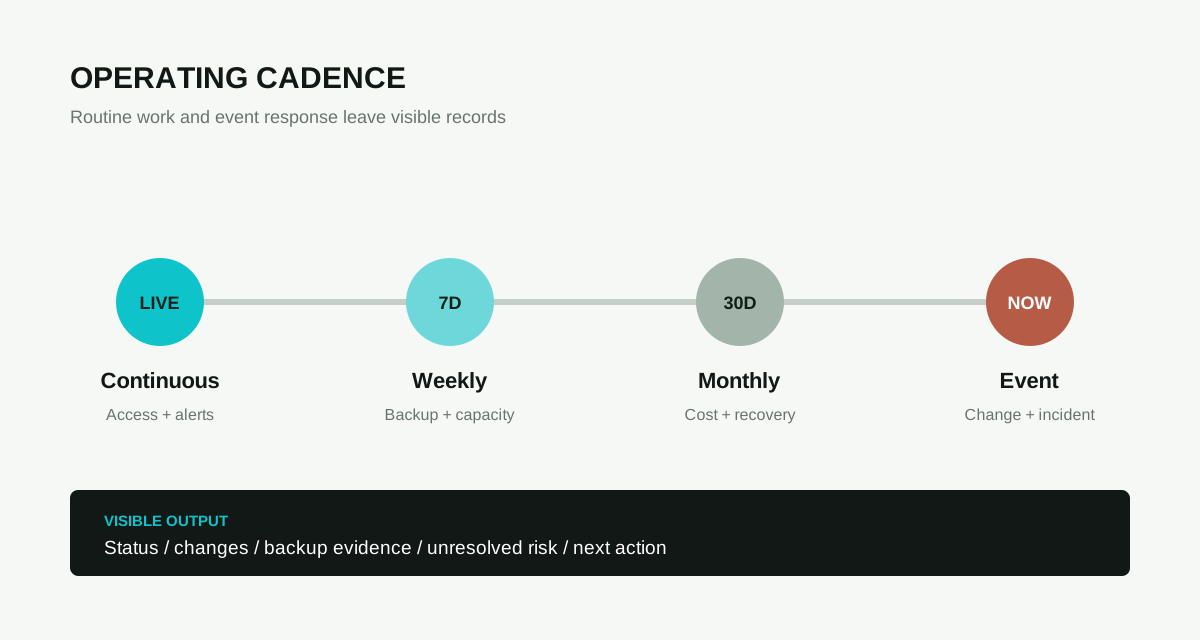
A public site, transaction system, and internal tool do not need the same cadence or recovery target. Classify impact first, then set monitoring and response depth.
| Cadence | Typical work | Visible output |
|---|---|---|
| Continuous or daily | External access, process, errors, capacity alerts | Alert state, response, unresolved items |
| Weekly | Backup completion, disk trend, TLS, updates | Check record, changed risk, priorities |
| Monthly | Permissions, cost, capacity, restore sample | Operating summary and recommendations |
| Event-triggered | Release, migration, vulnerability, outage | Change record, validation, rollback or review |
Monitoring must include what users experience
Healthy CPU does not prove that DNS resolves, TLS works, content is current, or form mail arrives. Combine resource, process, external-entry, and synthetic business checks. Grade alerts so a future certificate task differs from rapid disk growth and a fully unavailable critical path.
Backup status and recovery capability are different answers
A successful job may omit databases, configuration, or credentials. Confirm scope, isolation, retention, and recovery access, then perform sample restores.
Security maintenance is a continuous practice
Updates, least privilege, offboarding, administrative restrictions, logs, suspicious access, and vulnerability response all require ownership. Critical updates still need tests, backups, maintenance windows, and rollback so one repair does not create another outage.
The service boundary must state exclusions
Managed operations are not unlimited feature development and do not automatically absorb every code defect, provider suspension, attack, customer mistake, or capacity overage. Define check frequency, response window, backup scope, small-change policy, emergencies, and additional fees. Customers retain core accounts, independent data copies, and business decisions.
Measure managed work through records, not the absence of incidents
- Inventory assets, accounts, owners, and alternate contacts.
- Define monitoring, backup, RPO, RTO, and alert grades by business impact.
- Agree daily, weekly, monthly, and event-triggered work.
- Retain executable records for releases, permissions, updates, and recovery.
- Review scope, capacity, provider cost, and exit readiness periodically.
Small teams use managed operations because reliability requires continuous ownership, not because they lack technical ability. A clear operating system reduces repeated interruption while preserving control of critical assets and decisions.